
Injury library / Hip and groin
Hip and groin
Pain on the side of the hip at night
Pain on the outside of the hip that wakes you when you roll onto it is common, especially in women over 40. It is often called trochanteric bursitis, but the usual source is the tendons of your side glutes, and they are sensitive to being squeezed. How you lie, sit and stand matters as much as any exercise.
Jeff Shaverian · Physical therapy · KPM
Two common patterns
Pattern 1
Worse in bed and in certain positions
- Pain over the bony point at the side of your hip when you lie on it, sometimes spreading down the thigh
- Lying on the other side hurts too, once your top knee drops toward the bed
- Crossing your legs, a low soft sofa or standing hung on one hip brings it on
These positions press the tendons of gluteus medius and minimus, the side glutes that keep your pelvis level, against the bone. The iliotibial band (ITB), a thick strap down the outer thigh, presses harder as your knee moves across your body.
Pattern 2
Worse with walking, stairs and one leg
- An ache that builds with long walks, hills or stairs
- Standing on that leg to put on trousers or shoes sets it off
- It often starts after a jump in activity, or a return to running after a break
The tendon is doing more than it is ready for. In KPM terms (my movement-based approach) this often fits a hip adduction pattern: on one leg, the thigh drifts in and the pelvis drops or slides sideways, adding squeeze with every step.
Most people have some of both. The old name, bursitis, blames the bursa, a small fluid cushion over the bone, but scans show a swollen bursa in only a small share of people; the tendons are usually the problem. If your pain is in the front of the hip crease instead, read Pain at the front of the hip when you squat.
Why lying on it hurts
The side glute tendons attach over the greater trochanter, the bony point at the side of your hip. Tendons cope with pulling but dislike being pressed into bone, and the ITB lies over them like a strap. Lie on the sore side and your body weight presses them. Lie on the other side and the top knee drops, the hip bends and crosses your body, and the strap tightens over the top hip. Crossing your legs, low seats with your knees together and hanging on one hip do the same, more mildly, for hours a day.
That is why stretching the side of the hip tends to backfire: moving the knee across your body tightens the strap and adds squeeze in the wrong place. Complete rest rarely fixes it either, because tendons get stronger with gradual load. The answer is less squeeze, then a steady build of strength.
What to try this week
- Change how you lie. Sleep on your back, or on your good side with a firm pillow between your knees and shins so the top knee cannot drop. If you must lie on the sore side, a soft mattress topper may take some pressure off.
- Stand and sit level. Stand on both feet instead of hanging on one hip, and do not carry a child perched on that side. Uncross your legs, and choose a firm, higher seat or add a cushion so your hips sit above your knees.
- Stop stretching the side of your hip. Skip stretches that pull your knee across your body, standing side bends that push one hip out, and hard foam rolling of the outer thigh. They often feel good at the time and hurt more that night.
- Load it gently every day. Lie on your back with a belt looped above your knees and press gently outward into it for 20 to 30 seconds, 4 or 5 times. Keep walking, but go easy on hills and stairs. If your night pain is worse the next day, do less, and stop anything that sharply worsens the pain.
Safety first
See a doctor first, or call 115 in an emergency, if you have:
- Severe hip pain after a fall or injury, or you cannot walk or put weight on the leg
- Severe hip pain that started suddenly without a fall or injury
- A hip that is swollen and feels hot
- Pain, numbness or tingling shooting down the leg, or a leg that gives way under you
- Hip or leg pain with new trouble controlling your bladder or bowel
- Hip pain with a high temperature, night sweats or feeling generally unwell
- Constant pain that does not ease with rest or a change of position, or hip pain with unexplained weight loss or a past history of cancer
How I treat it
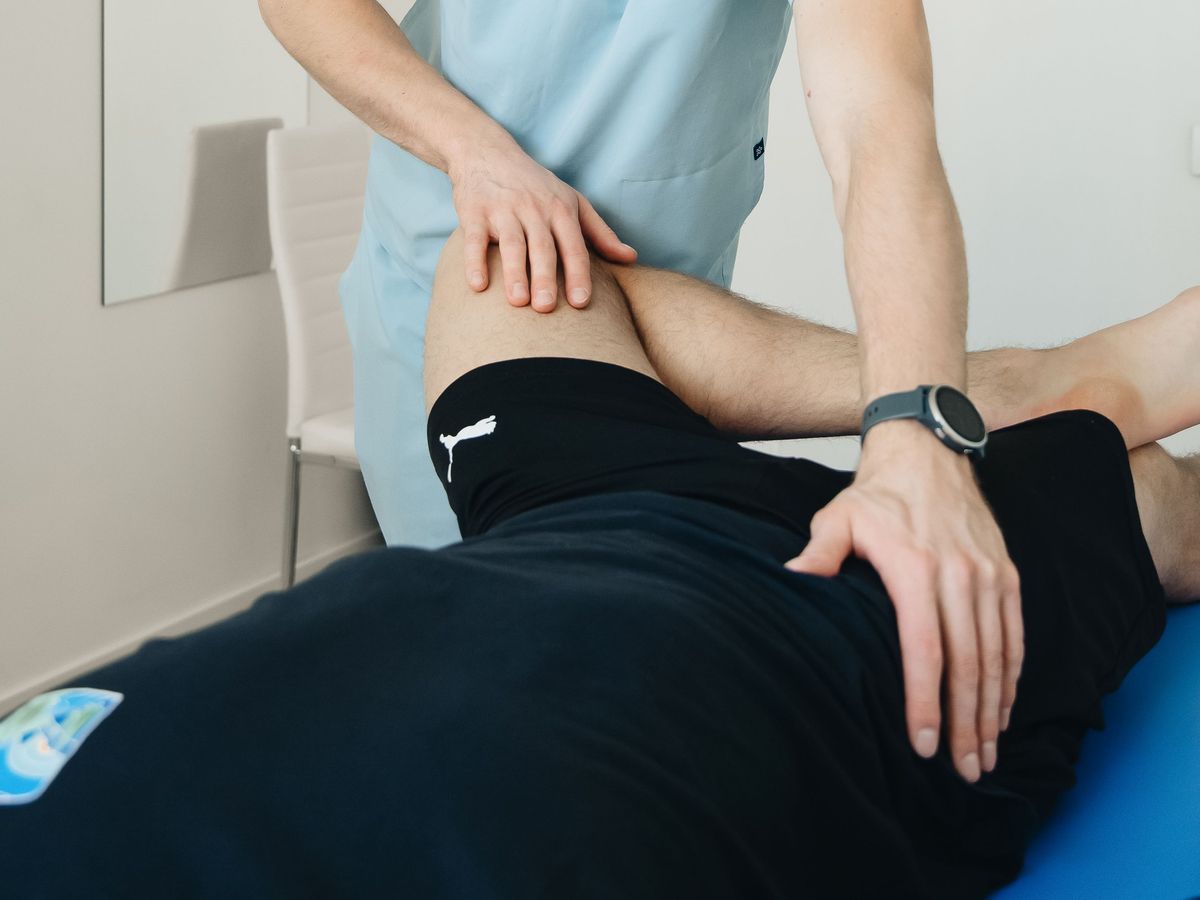
Your evaluation tests how you walk, stand on one leg, climb stairs and, if you train, squat and lunge. I watch for the hip dropping or sliding sideways, then change one thing at a time to see whether the pain changes. I also check your lower back, which can send pain to the same spot. Then we find the positions in your day and night that keep squeezing the tendon, and swap them out.
Loading starts with easy holds that calm pain, then strength work for the side glutes, then control on one leg in the tasks that hurt: stairs, lifts, running. Load goes up only while pain settles within 24 hours; if your night pain rises after a session, the dose was too high. A steroid injection often calms pain within weeks, but the effect tends to fade. Tendons adapt slowly, so think in months, not days. If you stop improving, I refer you to a sports or orthopaedic doctor.
Evidence note: in a trial of people with gluteal tendinopathy, education plus exercise beat a steroid injection and wait and see at 8 weeks, and still gave more overall improvement than the injection at one year, with similar pain (Mellor et al., BMJ, 2018). The exercise part is less clear: in women after menopause, strengthening was no better than sham exercise when both groups had the same education, though both groups improved (Ganderton et al., Journal of Women's Health, 2018).
Take the squeeze off
Injury evaluation, 1.000.000 VND (about $38), at My An Sport Center. The price includes access to the facility and equipment.
Sources
- Mellor R, et al. Education plus exercise versus corticosteroid injection use versus a wait and see approach on global outcome and pain from gluteal tendinopathy: prospective, single blinded, randomised clinical trial. BMJ. 2018;361:k1662. doi.org/10.1136/bmj.k1662
- Horschig A, Sonthana K. Rebuilding Milo. Las Vegas: Victory Belt Publishing; 2021. Chapter 2: Hip Pain.
- Grimaldi A, Fearon A. Gluteal tendinopathy: integrating pathomechanics and clinical features in its management. Journal of Orthopaedic and Sports Physical Therapy. 2015;45(11):910-922. doi.org/10.2519/jospt.2015.5829
- Ganderton C, et al. Gluteal loading versus sham exercises to improve pain and dysfunction in postmenopausal women with greater trochanteric pain syndrome: a randomized controlled trial. Journal of Women's Health. 2018;27(6):815-829. doi.org/10.1089/jwh.2017.6729
- NHS. Hip pain. Accessed October 2026. www.nhs.uk/symptoms/hip-pain/
- Sahrmann SA. Diagnosis and Treatment of Movement Impairment Syndromes. St Louis: Mosby; 2002.
This article is general education, not a diagnosis. Reviewed October 2026.