
Low back
Sciatica: what the leg pain is telling you
Sciatica is leg pain from an irritated nerve root in your lower back. It can be fierce and frightening, but most people get better without surgery, and the way your leg pain behaves tells us a lot about what to do next.
Jeff Shaverian · Physical therapy · KPM
Two kinds of leg pain
Pattern 1
Nerve root pain (sciatica)
- The leg hurts more than the back, usually on one side only
- Pain runs below the knee, often into the calf, foot or toes, and can feel sharp, burning or shooting
- Pins and needles, numbness or weakness in the same area, and coughing or sneezing can send it down the leg
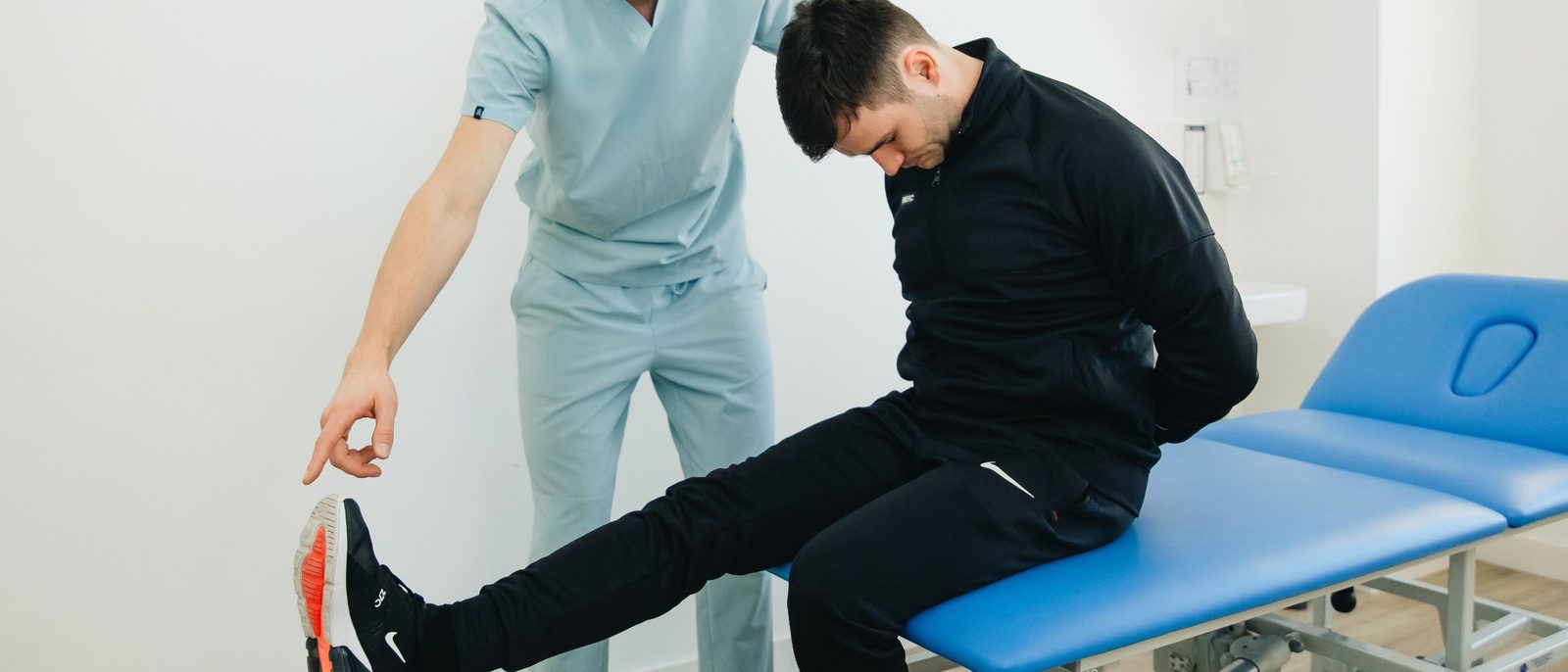
Lifting your straight leg while lying down often brings it on, because that pulls on the irritated nerve.
Pattern 2
Back pain that spreads
- The back is the main problem, and the leg pain rises and falls with it
- It stays in the buttock or thigh, usually above the knee, and feels more like a deep ache
- No pins and needles, numbness or weakness
This is common and does not mean a nerve is being pinched. It usually settles with the plan for the back pain itself.
Some people have a bit of both. If yours fits Pattern 2 and changes mostly with sitting or standing, read Back pain when you sit vs when you stand. If it fits Pattern 1, read on.
What the leg pain is telling you
Nerves leave your spine through small gaps between the vertebrae, the bones of your spine. The start of each nerve is called the nerve root. Roots in your lower back feed the sciatic nerve, which runs down the back of your leg to your foot. When a root is irritated, most often by a disc bulge and sometimes by a narrowed gap (stenosis), you feel it along the nerve. That is why your back can be the problem while your calf hurts.
The usual course is good. Most people improve over a few weeks to a few months, though for some it lingers. Surgery can ease the leg faster, but a year or two later, people who had it and people who did not tend to be in a similar place. Bed rest does not speed recovery.
Where the pain sits matters as much as how strong it is. If a movement or position makes the leg pain shrink back toward your spine, called centralisation, that is usually a good sign, even if your back still aches. People whose pain does this tend to recover better. Pain pushed further down the leg tells us to change course.
What to try this week
- Map your leg pain. Twice a day, note how far down it reaches (buttock, thigh, knee, calf or foot) and what you had just been doing. Pain retreating toward your back is good news. Pain creeping further down means change what you are doing.
- Move little and often. Short, easy walks through the day usually beat bed rest, and it is best to avoid long spells of sitting or lying. When you sit, get up at least every half hour. If a walk sends the pain further down, make the next one shorter.
- Find your easing positions. Try lying on your back with your knees bent, or on your side with a pillow between your knees. Use whichever quietens your leg, not just your back, and stop anything that sharply worsens the pain.
- Do not stretch into it. A tight feeling in the back of your thigh is often a reaction to the irritated nerve, not a short muscle. Hard hamstring stretches and toe touches pull on the nerve and can make things worse. Pause lifts that send pain down the leg, and keep training the rest.
Safety first
See a doctor first, or call 115 in an emergency, if you have:
- Numbness or tingling around your genitals, back passage or inner thighs, or new loss of feeling during sex: this is an emergency, call 115 or go to hospital now
- New trouble peeing, not feeling when your bladder is full, leaking urine, or losing control of your bowels: also an emergency
- Sciatica in both legs, or weakness or numbness in both legs that is severe or getting worse: this is also an emergency, call 115 or go to hospital now
- Leg weakness that is getting worse, or foot drop, where you cannot lift the front of your foot and your toes catch as you walk: get seen the same day
- Back or leg pain with fever, unexplained weight loss, a history of cancer, or after a fall, crash or other major injury
How I treat it

First I check the nerve itself: strength, feeling and reflexes in both legs, and how it tolerates a straight-leg raise. That tells us how irritated it is and whether you need a doctor first. Then I test sitting, bending, standing, lying and repeated movements, and watch where the leg pain goes. Whatever pulls it back toward your spine is our starting point.
Next, in KPM terms (my movement-based approach), I look for the everyday movement that keeps feeding the irritation, often a back that rounds to sit, bend and lift. We change it inside the tasks you actually do, from getting out of a car to the first pull of a deadlift. Hands-on treatment can help settle things, but alongside exercise, not instead of it.
As the leg settles, we load your back and hips again, a little at a time, while the leg stays quiet. Progress usually shows as pain that stays higher up the leg, for shorter spells. I will not promise a timeline. If your leg is not improving or weakness appears, I refer you to a doctor. Surgery is an option when leg pain does not settle and a scan matches your symptoms.
Evidence note: a systematic review found that when pain spreading from the spine moves back toward it during movement testing, people tend to have better outcomes, though the studies varied in quality (Aina et al., Manual Therapy, 2004).
Follow the leg pain
Injury evaluation, 1.000.000 VND (about $38), at My An Sport Center. The price includes access to the facility and equipment.
Sources
- National Institute for Health and Care Excellence. Low back pain and sciatica in over 16s: assessment and management (NG59). 2016, updated 2020. www.nice.org.uk/guidance/ng59
- Horschig A, Sonthana K. Rebuilding Milo. Las Vegas: Victory Belt Publishing; 2021. Chapter 1: Back Pain.
- Koes BW, van Tulder MW, Peul WC. Diagnosis and treatment of sciatica. BMJ. 2007;334(7607):1313. doi.org/10.1136/bmj.39223.428495.BE
- Aina A, May S, Clare H. The centralization phenomenon of spinal symptoms: a systematic review. Manual Therapy. 2004;9(3):134-143. doi.org/10.1016/j.math.2004.03.004
- NHS. Sciatica. NHS website, page last reviewed 3 December 2024. www.nhs.uk/conditions/sciatica/
- Sahrmann SA. Diagnosis and Treatment of Movement Impairment Syndromes. St Louis: Mosby; 2002.
This article is general education, not a diagnosis. Reviewed October 2026.