
Knee
Jumper's knee: loading the tendon back
If you can point to the pain with one finger, just below your kneecap, and it bites when you jump, land or squat deep, your patellar tendon is the likely source. This is patellar tendinopathy, or jumper's knee: the tendon joining kneecap to shin has been overloaded and lost some of its tolerance for load. Rest quiets it, but loading it back in stages is what usually fixes it.
Jeff Shaverian · Physical therapy · KPM
Two ways it shows up
Pattern 1
A new flare after a spike in load
- It began after a sudden rise in training, like one brutal session or suddenly training every day
- Or you went straight back to your old programme after a few weeks off
- It is sore to press, and the next day you may limp
Caught early, with the load turned down, a first flare can settle within weeks. Training straight through it risks Pattern 2.
Pattern 2
A knee that keeps flaring
- It has come and gone for months
- It eases once you warm up, then aches more later or the next morning
- Your jumps feel weaker, as if the leg is holding back
Time off quiets it, then it returns with the jumping. It needs the full staged plan below, usually over months.
Sitting and lying down usually feel fine. If your ache is spread around or behind the kneecap instead of at one point, read my article on pain at the front of the knee on stairs.
Why rest alone lets you down
Your patellar tendon acts like a spring: it stores energy as you land and releases it as you push off. So jumping, landing and hopping load it far more than a slow squat, which is why basketball and volleyball produce so many cases, and why Olympic lifts can set it off too. Deep squats with the knee far forward load it more too, and stairs can bother it.
A tendon is built for the load it is used to. Ask a little more and it adapts. Ask far more, with a sudden spike in training or a fast return after a break, and it reacts and gets sore. How much load you do, and how fast it rises, usually matter more than one faulty movement. Landing still counts, though: stiff ankles pass more of the landing force up to the knee.
Full rest feels safe, but a resting tendon adapts too, downwards. The pain fades, the tendon now handles less, and your old training overloads it again. Pushing through pain is the opposite mistake. Tendons often complain the day after a session rather than during it, so the next morning is your best guide to how much is enough. Ice and anti-inflammatories can dull the pain, but inflammation is not the main problem.
What to try this week
- Turn the load down, not off. For now, cut back jumping, hopping, sprinting and deep loaded squats, and keep doing whatever does not hurt.
- Change one thing at a time. If you train, drop one session a week or cut your jumps and heaviest sets, then wait a few days before changing anything else.
- Check it the next morning. Do a slow half squat on the sore leg, holding on for balance, and rate the pain from 0 to 10. If it is the same or better than yesterday, yesterday's load was fine. If it is clearly worse, do less today.
- Try an easy hold. Once a day, lean your back against a wall, slide down only as far as is comfortable and hold for 30 to 45 seconds, three or four times. Some people find this eases the pain for a while, though studies disagree on how reliably. Stop if it sharply worsens.
Safety first
See a doctor first, or call 115 in an emergency, if you have:
- Sudden sharp pain at the kneecap, often with a pop, then you cannot straighten the knee or lift the leg out straight
- Knee pain after a fall, a crash or a hard twist, with fast swelling or trouble taking weight on the leg
- A hot, red, swollen knee, or knee pain with a fever or feeling unwell
- A knee that locks or gives way
- Pain, swelling or throbbing in the calf or behind the knee, especially after a long flight, surgery or bed rest
- Numbness or tingling in the leg or foot
How I treat it
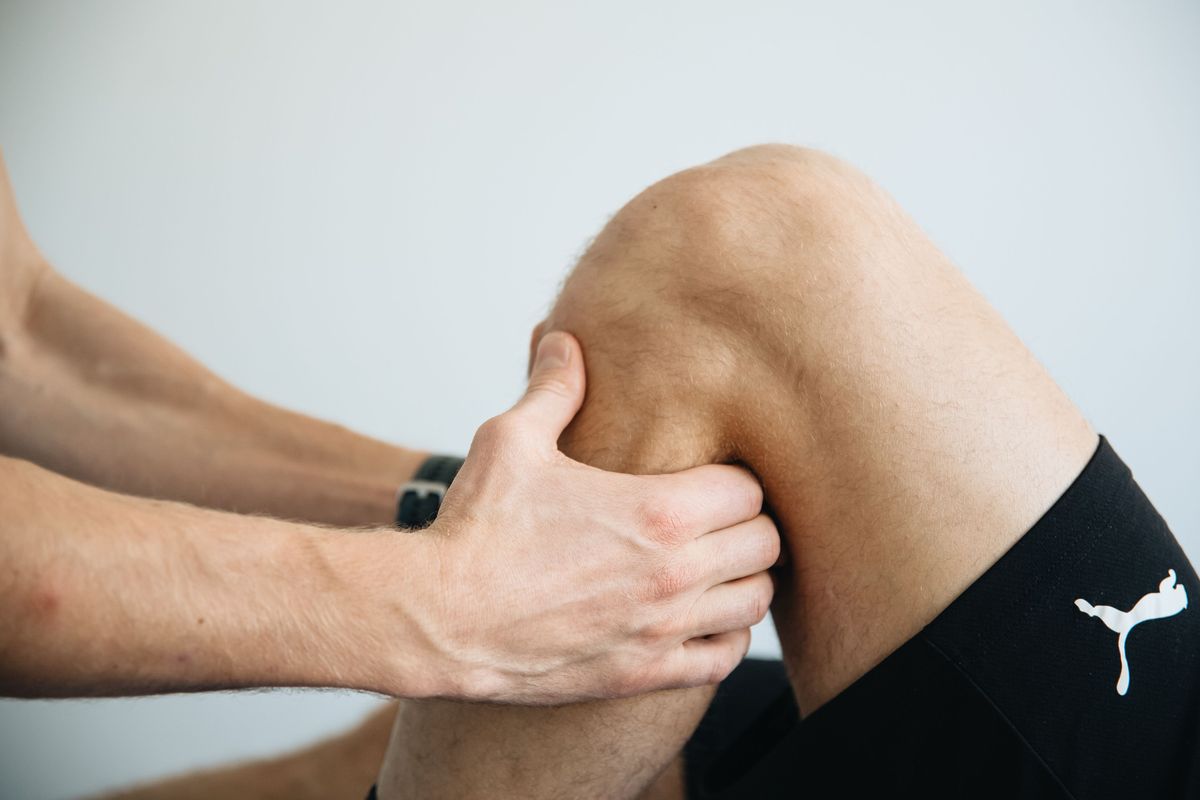
Your evaluation first confirms it is the tendon: where exactly it hurts, and whether the pain climbs with load, from a slow squat up to hops. Then, using KPM, my movement-based approach, I check how you squat and land and how your ankles and hips move, changing one thing at a time to see what changes the pain.
Then we load it back in stages. First, holds: the muscle works hard while the knee stays still. Next, slow, heavy strength work such as squats and split squats. Then energy storage, from soft landings and small hops up to jumps. Last comes your sport, brought back gradually. Pain up to about 3 out of 10 during the work is usually fine, and the next-morning response decides whether we progress or ease off.
Recovery often takes months, and longer if the knee has flared on and off for a long time. Injections, scraping and machines may dull the pain, but they do not rebuild the tendon. A strap below the kneecap helps some people short term, alongside rehab rather than instead of it. Once you are back, some strength work each week helps keep it away.
Evidence note: in a trial of 76 people with patellar tendinopathy, a staged loading programme (holds, strength, jumping, then sport) did better at 24 weeks than lowering-only squats on a slope board (Breda et al., British Journal of Sports Medicine, 2021). An early small study found holds eased pain more than moving exercise, but later research found no clear difference (Clifford et al., BMJ Open Sport and Exercise Medicine, 2020).
Build it back
Injury evaluation, 1.000.000 VND (about $38), at My An Sport Center. The price includes access to the facility and equipment.
Sources
- Breda SJ, et al. Effectiveness of progressive tendon-loading exercise therapy in patients with patellar tendinopathy: a randomised clinical trial. British Journal of Sports Medicine. 2021;55(9):501-509. doi.org/10.1136/bjsports-2020-103403
- Horschig A, Sonthana K. Rebuilding Milo. Las Vegas: Victory Belt Publishing; 2021. Chapter 3: Knee Pain.
- Malliaras P, et al. Patellar tendinopathy: clinical diagnosis, load management, and advice for challenging case presentations. Journal of Orthopaedic and Sports Physical Therapy. 2015;45(11):887-898. doi.org/10.2519/jospt.2015.5987
- Rio E, et al. Isometric exercise induces analgesia and reduces inhibition in patellar tendinopathy. British Journal of Sports Medicine. 2015;49(19):1277-1283. doi.org/10.1136/bjsports-2014-094386
- Holden S, et al. Isometric exercise and pain in patellar tendinopathy: a randomized crossover trial. Journal of Science and Medicine in Sport. 2020;23(3):208-214. doi.org/10.1016/j.jsams.2019.09.015
- Clifford C, et al. Effectiveness of isometric exercise in the management of tendinopathy: a systematic review and meta-analysis of randomised trials. BMJ Open Sport and Exercise Medicine. 2020;6(1):e000760. doi.org/10.1136/bmjsem-2020-000760
This article is general education, not a diagnosis. Reviewed October 2026.