
Injury library / Neck and upper back
Neck and upper back
Desk neck: it is rarely one bad posture
Most people with a sore neck after work blame their posture. Research suggests the angle of your neck on its own is a weak predictor of pain. In my assessments, time spent without moving, how your neck and shoulder blades share the work, and your overall load are usually more useful to look at.
Jeff Shaverian · Physical therapy · KPM

Two common patterns
Pattern 1
Builds the longer you sit or scroll
- An ache at the base of your neck or between your shoulder blades that grows through the day
- Long calls, laptop work or phone time on the sofa make it worse
- Getting up, moving around or lying down usually eases it
In KPM terms this often fits a flexion pattern held for long periods: the neck stays in one position, often bent forward, for hours. The angle itself may matter less than how long the same tissues hold it without a break.
Pattern 2
Catches when you turn, look up or use your arms
- A sharper pinch on one side when you check a blind spot or look up at a shelf
- Carrying a bag, reaching for the mouse or working with your arms overhead sets it off
- Resting your forearms on a desk or armrest can ease it
This fits a rotation or extension pattern (turning or tipping the head back). The shoulder blades may sit low or rotate poorly, so the muscles running from your neck to your shoulder blades end up holding the weight of your arms.
Many people have a bit of both, and some also get headaches that start at the base of the skull and spread forward. These are called cervicogenic headaches, meaning they come from the neck. Finding which movements and positions set your neck off, and which ones settle it, is the first job of the assessment.
Why posture alone is not the answer
You have probably been told to sit up straight. The evidence for that is weaker than most people think. In a study of 582 adults, how far people bent their neck to type on a phone was not linked to whether they had neck pain, how often it came on, or how bad it got. A review of office workers found only a handful of physical factors that predicted who went on to develop neck pain. Among them were little variety in work tasks and feeling a moderate to high level of muscle tension.
What I find more useful is the load picture. Your neck holds up your head and helps carry your arms all day. When you stay in one position for hours, the same small muscles and joints take that load without a break. In my assessment I look closely at the shoulder blades: if they do not rotate up well as your arms work, the neck muscles pick up extra work. Add a sudden jump in screen hours, and a neck that coped fine can start to complain.
What to try this week
- Track it for three days. Note which positions and movements bring the pain on, and what settles it. It is the most useful thing you can bring to an evaluation.
- Change position often. Your best position is usually your next one. Every 20 to 30 minutes, stand up, look around the room and let your arms hang. If looking down sets it off, raise your screen or hold your phone a little higher.
- Take the weight off your arms. Rest your forearms on the desk or on armrests while you type, so your neck and shoulders are not holding your arms up. Swap the hand that carries your bag, or use a backpack with both straps.
- Keep your neck moving gently. A few times a day, slowly turn your head side to side, nod your chin down and up, and roll your shoulders. Stay in a comfortable range, and stop if a movement causes sharp pain or sends pain, pins and needles or numbness down your arm.
Safety first
See a doctor first, or call 115 in an emergency, if you have:
- New dizziness, double vision, slurred speech, trouble swallowing, or sudden falls without fainting (drop attacks)
- Numbness, tingling or weakness in both arms or in your legs, or weakness in one arm that is getting worse
- New clumsiness in your hands, such as dropping things, or unsteady walking
- Neck pain after a fall, a crash or another major injury
- Fever with a stiff neck, or neck pain with unexplained weight loss or a history of cancer
- A sudden, severe headache that feels like the worst of your life
How I treat it
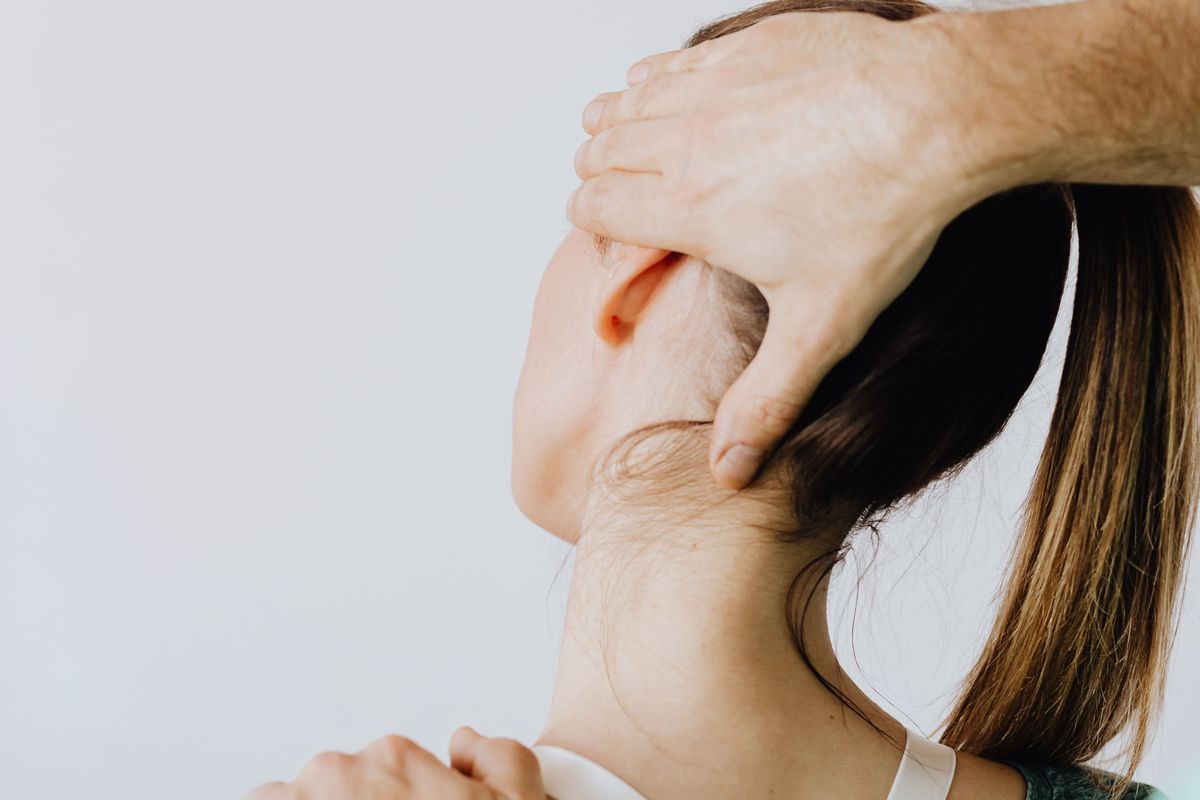
Your evaluation tests the movements and positions that bring your symptoms on: turning, looking up and down, sitting at a screen, reaching and carrying. I watch how your neck moves and how your shoulder blades and upper back share the work, then change one thing at a time, such as supporting your arms or changing how you turn your head. When a change in how you move changes your pain, we know what to work on.
From there, sessions combine hands-on treatment for the neck and upper back where it suits you, such as mobilisation (slow, controlled movement of a stiff joint by the therapist), with exercise for the neck and shoulder blades. We build those changes into your workday, then add load until they hold. If headaches come from your neck, the same approach applies. Expect to work at it for weeks rather than days. I cannot promise a timeline, but you will see what is changing at each step.
Evidence note: in a study of 582 adults, the angle of the neck while typing on a phone was not linked to neck pain (Correia et al., Spine, 2021), and the US physical therapy guideline for ongoing neck pain with stiffness recommends hands-on treatment combined with neck and shoulder blade exercise (Blanpied et al., JOSPT, 2017).
Find the trigger
Injury evaluation, 1.000.000 VND (about $38), at My An Sport Center. The price includes access to the facility and equipment.
Sources
- Blanpied PR, et al. Neck pain: revision 2017. Clinical practice guidelines linked to the International Classification of Functioning, Disability and Health from the Orthopaedic Section of the American Physical Therapy Association. Journal of Orthopaedic and Sports Physical Therapy. 2017;47(7):A1-A83. doi.org/10.2519/jospt.2017.0302
- Correia IMT, et al. Association between text neck and neck pain in adults. Spine. 2021;46(9):571-578. doi.org/10.1097/BRS.0000000000003854
- Jun D, et al. Physical risk factors for developing non-specific neck pain in office workers: a systematic review and meta-analysis. International Archives of Occupational and Environmental Health. 2017;90(5):373-410. doi.org/10.1007/s00420-017-1205-3
- Jull G, et al. A randomized controlled trial of exercise and manipulative therapy for cervicogenic headache. Spine. 2002;27(17):1835-1843. doi.org/10.1097/00007632-200209010-00004
- Sahrmann SA and associates. Movement System Impairment Syndromes of the Extremities, Cervical and Thoracic Spines. St Louis: Elsevier/Mosby; 2011.
This article is general education, not a diagnosis. Reviewed October 2026.